 Celebrate with up to 80% off
Online gambling scams: Warning signs, real risks, and how to stay safe


Online gambling has become a popular form of digital entertainment, with 2025 poll data from the American Psychiatric Association (APA) showing that more than 1 in 4 American adults place bets and play casino games from their phones and computers every day.
Much of this activity takes place on legitimate, licensed platforms. However, that popularity also draws scammers who target players with fraudulent websites, fake promotions, phishing attacks, and other schemes designed to steal money or personal information.
Some scams imitate legitimate gambling brands, while others create entirely fake casinos or betting sites. In many cases, the warning signs are easy to miss until a player encounters problems with deposits, withdrawals, or account access.
Understanding how these scams work can help you make more informed decisions when choosing gambling platforms and interacting with gambling-related offers online.
What are online gambling scams?
Online gambling scams are fraudulent schemes that use betting, casino games, sports wagering, poker, or gambling apps as a cover to deceive people. Unlike normal gambling losses, which happen when someone places a bet and loses fairly, gambling scams involve deliberate manipulation or dishonesty.
For example, a scam may also involve refusing to pay out winnings, inventing account problems to demand extra fees, advertising bonuses with misleading terms, or using rigged games that make fair play impossible. In each case, the issue is not simply that the player lost money. It is that the person or platform used deception to steal money, data, or access to an account.
The most common online gambling scams
Online gambling scams come in many forms. Some scams target people before they join a gambling platform, while others occur after a player has already created an account. Understanding the most common scam types and how they happen can make it easier to recognize suspicious behavior before it leads to financial losses or compromised accounts.
Here are some common types of online gambling scams you’re likely to come across.
Fake online casinos and betting sites
A fake online casino or betting site is designed to look like a legitimate gambling platform while operating solely to collect deposits or personal information. These sites often copy the appearance of established gambling brands, including logos, game libraries, and promotional offers.
Players might be able to create accounts and deposit funds without issue. The problems usually begin when they try to withdraw winnings or verify their identity. In many cases, withdrawals are delayed indefinitely or denied altogether.
Withdrawal and payout scams
Withdrawal scams occur when a gambling platform accepts deposits but creates obstacles when users attempt to cash out their funds.
Some operators repeatedly request additional verification documents, introduce unexpected fees, or impose new conditions that weren't clearly disclosed when the account was created. Others stop responding to customer support inquiries altogether.
Scammers might also claim that a player must make another deposit before a withdrawal can be processed. Legitimate operators generally don't require additional deposits to release winnings.
Rigged games and manipulated odds
Some fraudulent platforms use manipulated software that reduces a player's chances of winning beyond what would normally be expected. Others misrepresent the odds offered or change betting terms in ways that were not clearly disclosed.
Because these practices happen behind the scenes, players generally have no reliable way to detect them.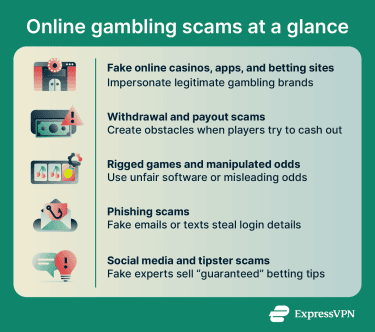
Phishing and account takeover scams
In this scam, the scammer sends an email or text message claiming to come from a gambling platform. The message might warn about suspicious account activity, offer a bonus, or request account verification. The goal is to persuade the recipient to click a fraudulent link and enter login credentials, payment information, or personal details.
Once scammers obtain account credentials, they might attempt an account takeover, which could allow them to access stored payment methods, transfer funds, or change account details.
Players who reuse passwords across multiple websites face an additional risk of credential stuffing attacks if those credentials become exposed in a data breach elsewhere.
Fake gambling apps and software
A fake app might appear in an app store or spread through a direct download link, then request broad permissions, display fabricated winnings to encourage deposits, or covertly collect personal and financial data.
Betting systems and prediction software fall into a similar category. These are sold with claims of guaranteed wins, which no legitimate tool can deliver, since outcomes in licensed games and regulated betting markets aren't predictable. In these cases, the product itself is the scam.
Social media and tipster scams
Social media platforms, messaging apps, and online forums have become common channels for online gambling scams. One common tactic involves fake betting experts, often called tipsters or handicappers. These individuals claim to have insider knowledge, sure-bet picks, or exclusive betting systems. They typically charge fees for access to their predictions or private groups.
In reality, many fraudulent handicappers use misleading statistics, fabricated success rates, or selective reporting to appear successful. Some simply disappear after receiving payment.
Warning signs of an online gambling scam
Scammers often adapt their tactics to different audiences, but most online gambling scams still share a few recognizable traits. Here's what to watch for.
Promises that seem too good to be true
Gambling outcomes are inherently uncertain. Any platform, tipster, or promoter claiming otherwise is attempting to mislead potential customers.
Be cautious if a site or individual promises:
- Assured winnings
- Risk-free betting with no possibility of loss
- Exceptionally large bonuses with few conditions
- Insider information that supposedly guarantees success
- Consistent profits from gambling
Unlicensed or unregulated operators
A legitimate gambling site should be transparent about its licensing and regulatory status. Fraudulent operators sometimes display fake license numbers, copy regulator logos without authorization, or provide licensing information that can’t be verified. Others don’t even attempt to appear regulated.
To confirm whether a gambling site or online casino has a valid license:
- Find the licensing details, usually listed in the website footer, terms of service, or dedicated licensing pages.
- Note the regulator's name and the license number.
- Go to the regulator's official website and look up that number directly, rather than trusting a logo or link on the gambling site itself.
It's also important to verify that the operator is authorized to offer gambling services in your jurisdiction. A valid license in one state or country doesn't necessarily mean the site can legally serve players in another.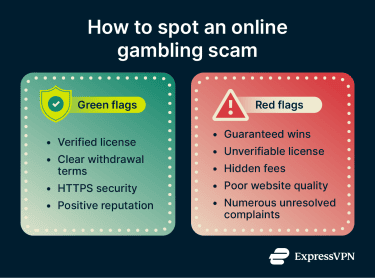
Poor website security and design
A professional-looking website doesn't guarantee legitimacy, but poor web design and security can be a warning sign.
Some fraudulent gambling sites use outdated designs, copied content, or suspicious URLs that don't match the advertised brand. Other potential warning signs include broken links or missing pages, missing privacy policies or terms of service, and security warnings from your browser.
That said, it’s important to remember that criminals now have access to generative AI tools, which makes it far easier for them to create convincing, professional-looking content. This is why you should look beyond design and pay attention to basic security features. For example, a gambling site that asks for payment information without using HTTPS encryption raises serious concerns.
Negative reviews and unresolved complaints
A few negative reviews are normal for almost any online service. However, consistent complaints about withheld winnings, blocked withdrawals, account closures, or poor customer support may indicate larger problems.
When researching a platform, look for patterns rather than isolated incidents. Questions worth considering include:
- Do multiple users report the same issues?
- Has the operator responded to complaints?
- Are complaints recent and ongoing?
- Do reviews appear authentic or overly promotional?
Rather than relying solely on testimonials displayed on the operator's own website, look for feedback from multiple independent sources. Search for reviews, forum discussions, complaint reports, and news coverage related to the operator.
How to protect yourself from online gambling scams
No method can eliminate risk entirely, but a few simple precautions can significantly reduce the chances of becoming a victim of online gambling fraud. A practical way to reduce risk is to combine careful platform selection with good cybersecurity habits. This helps protect both your money and your personal information.
Use trusted and regulated platforms
One of the simplest ways to reduce the risk of falling victim to online casino scams is to use gambling platforms that are regulated by recognized authorities.
Before creating an account, verify the operator's licensing information, company details, withdrawal policies, and reputation. Established operators are generally more transparent about their policies, security measures, and dispute-resolution procedures.
It's also a good idea to exercise caution when it comes to newly launched platforms with little public history or independent feedback.
Verify local gambling laws and operator authorization
Before signing up, check whether online gambling is legal in your state, province, territory, or country and whether the operator is authorized to serve players there. The easiest way to do this is to visit your local gambling regulator's website and review its list of licensed or approved operators.
Don’t assume that a site is legal in your area simply because it holds a license somewhere else. Some gambling sites hold legitimate licenses but aren’t permitted to operate in every jurisdiction. If a dispute arises, players using unauthorized operators may face extra challenges when seeking assistance from regulators or pursuing complaints.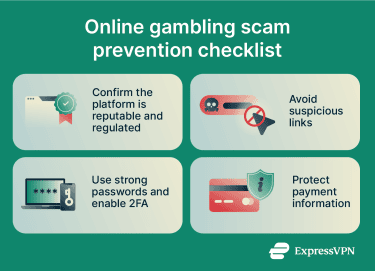
Avoid suspicious links and advertisements
Scammers frequently use advertisements, emails, text messages, social media posts, and messaging apps to lure users to fake betting websites. Instead of clicking links directly from promotions, consider navigating to the operator's website manually or through a trusted bookmark. This reduces the risk of landing on a phishing page designed to steal account credentials or payment information.
You might also consider using tools that help block malicious domains for an additional layer of protection. For example, ExpressVPN's Threat Manager helps prevent apps and websites from communicating with known malicious domains on its blocklist, which can reduce exposure to certain phishing and scam-related websites.
Enable strong account security
Gambling accounts often contain personal information, payment methods, and account balances, making them attractive targets for cybercriminals. Using a strong, unique password for every gambling account reduces the risk of account takeover attacks.
A reputable password manager like ExpressKeys can help you avoid password reuse by generating and securely storing unique passwords for all your accounts. It even supports passkeys, which offer even stronger protection by eliminating many of the weaknesses associated with traditional passwords.
Besides a strong password, you should also enable two-factor authentication (2FA) when available, monitor account login activity regularly, and update passwords after a known breach.
Protect your payment information
Online gambling platforms typically require payment details to process deposits and withdrawals. Protecting this information is an important part of reducing your credit card fraud risk.
Only enter payment information on websites you trust and have verified. Avoid sharing card details through email, messaging apps, or unofficial customer support channels. Even then, share only the information a legitimate operator actually needs to process a deposit or payout. A gambling site has no reason to ask for your full banking login, for example.
Where possible, use payment methods that offer some buyer protection, and steer clear of sending money through hard-to-reverse channels like wire transfers.
Additional precautions you can take include monitoring your financial statements regularly and removing unused payment methods from dormant accounts.
What to do if you have been scammed
If you've been targeted by an online gambling scam, the actions below can help protect your finances, accounts, and personal information while creating a record of what happened.
Stop further payments immediately
If you suspect you've been dealing with a fraudulent gambling site or scammer, stop sending money right away.
Scammers often attempt to extract additional payments by claiming that funds are needed to unlock winnings, verify accounts, cover taxes, or process withdrawals. Legitimate gambling operators don't require unexpected payments simply to release winnings.
Avoid making additional deposits, responding to payment requests, or clicking links sent by the suspected scammer. Additionally, cancel any recurring payments or subscriptions linked to the site, and don't hand over new payment details, even if you're told they're needed to fix the problem or recover what you've already lost.
Document evidence and communications
Keep a record of everything related to the scam. This includes screenshots of the site or app, transaction records, emails or messages, the site's web address, customer support conversations, and any account or reference numbers.
Good documentation supports the reports you make to your bank and the authorities, and it can help if you dispute a charge.
Contact your bank or payment provider
If you've already shared payment information or sent money to a scammer, contact your bank, card issuer, or payment provider as soon as possible. Depending on the circumstances, they may be able to:
- Block further transactions
- Freeze affected cards or accounts
- Issue replacement cards
- Investigate unauthorized payments
- Explain available dispute or chargeback options
Provide as much information as possible, including transaction dates, amounts, and any communications you've received from the suspected scammer. Early reporting may improve the likelihood of preventing further unauthorized activity and additional losses.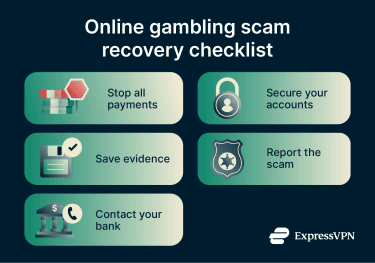
Secure your gambling and financial accounts
If you shared login or payment details, treat the related accounts as compromised. Review recent account activity, remove any unauthorized devices or sessions, and secure the account, as well as any other accounts that used the same password.
If identity documents were shared with a fraudulent site, monitor your credit reports for unusual activity. In this case, it could also be worthwhile to use a tool like ExpressVPN’s Identity Defender, which can monitor the dark web and alert you if your info is found there, as well as scanning your credit activity to help spot signs of possible fraud sooner. Identity Defender is available to U.S. users on the ExpressVPN Advanced and Express Pro plans.
Report the scam to the relevant authorities
Reporting a scam may help authorities identify fraudulent operators and protect other potential victims. It also creates a record and can support any claim you make.
The appropriate reporting channel depends on your location and the type of scam involved. In the U.S., you can report any cybercrime to the FBI’s Internet Crime Complaint Center (IC3). Other potential reporting options include consumer protection agencies, financial regulators, local law enforcement, and gambling regulators.
If the scam occurred through a social media platform, app store, or online marketplace, consider reporting it directly to the platform as well.
Watch out for recovery scams
After a scam is reported, victims are sometimes contacted by individuals or companies claiming they can recover lost funds for an upfront fee. These offers are often scams themselves. Be extremely wary of anyone guaranteeing that money can be recovered in exchange for payment.
FAQ
Can you recover money lost to an online gambling scam?
Are online casinos legal everywhere?
What information should I never share with a gambling site?
How do scammers target sports bettors?